

•
Discover the cost to install a ceiling fan, including labor, materials, and tips to save. Learn what impacts your price and how to budget for your project.
Keep your home’s temperature just right with one simple switch

Your ceiling fan's winter direction is clockwise on low speed, which pulls cool air up and pushes warm air trapped near the ceiling back down throughout your room.
Expect to pay $145 to $355 for professional ceiling fan installation, and you can save up to $40 per month by pairing your fan with air conditioning.
You should switch your ceiling fan direction during Daylight Saving Time, changing to counterclockwise in spring and clockwise in fall for year-round comfort.
Hiring a local ceiling fan installation professional keeps installation, repairs, and direction adjustments simple while ensuring your fan operates correctly for maximum energy savings.
If you’re searching for a way to lower your energy bills and keep your home at the perfect temperature, look no further. Adjusting the direction of your ceiling fan can help you beat the summer heat and winter chill. With this easy switch, you’ll see your home’s temperature fall into place and your energy bills plummet. Keep on reading to learn more about the directions of your fan and how to adjust it.
You may be used to keeping your ceiling fan off in winter, due to colder temperatures. But did you know keeping it on can actually keep you warmer?
During winter, turn your ceiling fan on a low speed rotating clockwise. This will create an updraft that will move trapped warm air near the ceiling down and around the room. Your room temperature will increase and your heating bills will fall.
To see if your fan is rotating clockwise, stand underneath it and observe the blades. You should see them moving from left to right.
Your ceiling fan is probably your trusty tool for beating the summer heat. Putting your ceiling fan to use during the summer keeps the heat and your energy bill down. The fan creates a wind chill effect that lowers your body temperature. Moisture evaporates quicker when the air hits your skin, which in turn makes your body feel cooler.
To ensure you’re getting the full cooling effects, make sure it’s spinning counterclockwise. This direction causes the fan to create a downdraft, which keeps that cool breeze flowing through your home.
Check if your fan is rotating counterclockwise by standing underneath and watching the blades spin. They should be moving from right to left. You should feel a direct, cool breeze flowing down from the fan.
Pairing your ceiling fan with air conditioning during the summer is the perfect combo for cost-effective cooling. An air conditioner alone uses roughly 3,500 watts of power, while a ceiling fan only uses 50 watts. Pairing the two together helps you lower the energy use within your home and still keeps you feeling cool.
The wind chill effect of the fan keeps your body temperature down and makes the temperature feel four degrees cooler. This allows you to turn up the thermostat four degrees and save money on cooling costs. Homeowners on average can save up to $40 per month by using a ceiling fan with air conditioning.

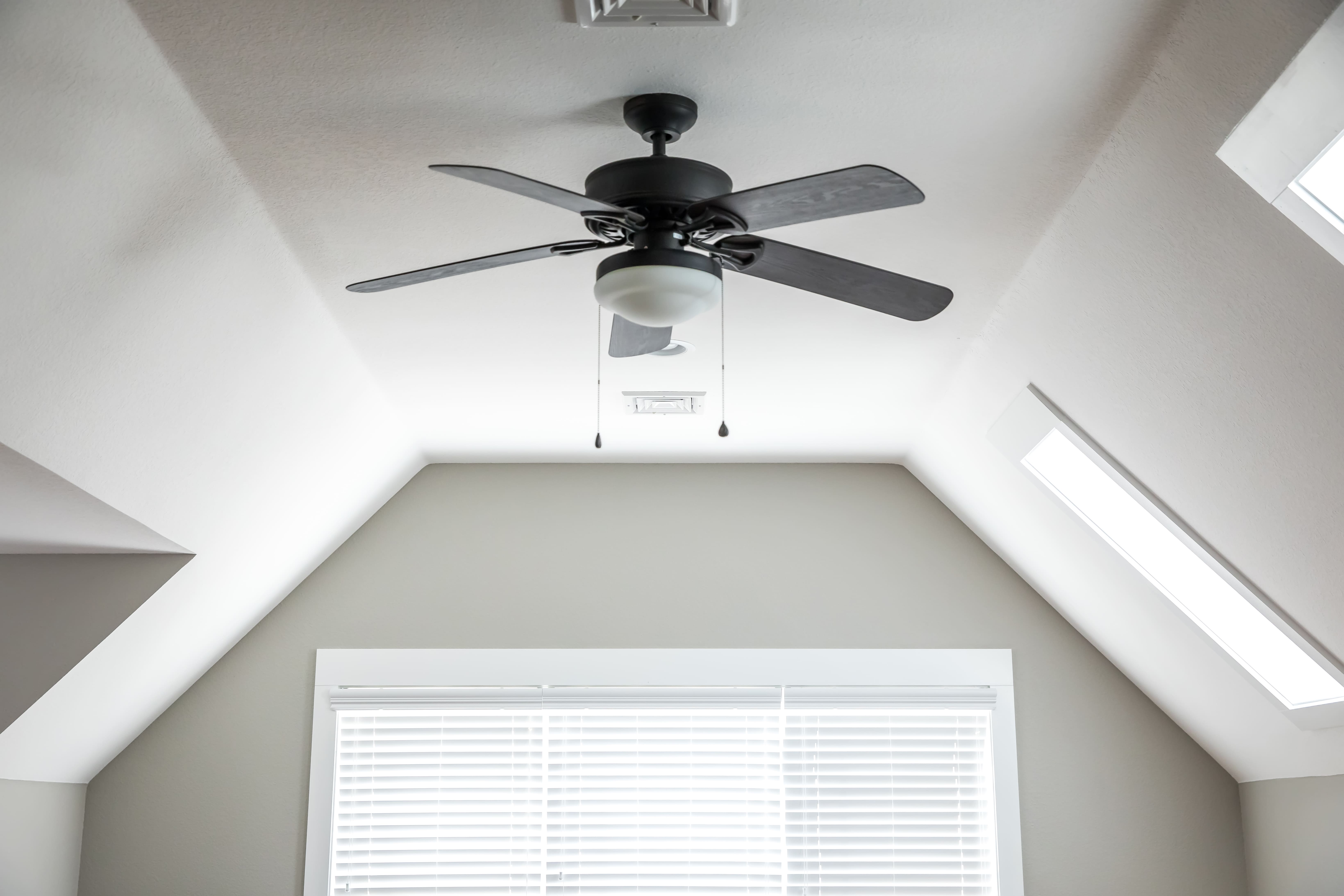
There are two main models of ceiling fans: pull chains and remote fans. How you change the direction of the blades differs depending on which model you have.
To switch directions for a pull-chain ceiling fan:
Turn off the fan and allow the blades to stop
Locate the switch on the fan body or fixture housing
Push the switch in the opposite direction
Turn the fan back on
Stand under the fan and observe the blades to check if the direction has changed
To switch directions for a remote ceiling fan:
Turn the fan off and let the blades stop moving
Grab the remote and press the fan button until the light blinks
Turn the fan back on
Observe the blades to ensure the direction has changed
The general rule for changing your ceiling fan direction is to follow Daylight Saving Time.
When the clocks spring forward, change your fan to spin counterclockwise.
When the clocks fall back, change your fan to spin clockwise.
You can also change the direction based on your local temperatures. Put it in winter mode when temperatures drop, and summer mode when they rise.
You should also use your bi-annual switch-up as a time for ceiling fan maintenance. Dust, debris, and dander can build up on your ceiling fan blades over time or when it’s not in use.
Clean them using a long-handled duster, or climb up on a ladder and wipe down the blades.
Check for any signs of damage including loose parts, cracks, or misaligned blades.
If you run into any issues with your ceiling fan or are looking to install a new one, contact a ceiling fan technician near you. Or if you’re looking to add a ceiling fan for the cost savings, you can talk to the technician about your options. The average cost to install a ceiling fan runs from $145 to $355. The technician will be able to answer any questions you have, along with completing any repairs, installs, or replacements so you can stay cool or warm whenever you want.
Great company! Price was competitive, technician showed up on time and completed the job (exterior electric Radon fan replacement) quickly. Would hire them again.
 MaGen Property Inspections and Radon Mitigation
Best decision was going with PatchMaster. Greg was wonderful / responsive & Dave did wonderful work. Got me on the schedule quick, matched my popcorn ceiling perfectly, finished the job quick, and was so kind & reasonably priced. Will absolutely be hiring again
 PatchMaster
Jeff was a consummate professional. Responsive, courteous, and focused on meeting our needs. I had a small project of installing and replacing two ceiling light fixtures. He responded to my Home Advisory inquiry within 24 hours and in a span of two weeks our light fixtures were installed. ...
Involved an extensive bathroom remodel, including removing tub & installing walk in shower, new drywall, custome tile work to ceiling, plumbing, etc. Overall, job was done on time and on budget. Nick & his team were very professional and had high attention to detail. Quality was great. Highly...
 Stamos Flooring and Remodeling LLC
Mike and his crew did a great job working through a very challenging task. The job required a full demolition of our ceiling, removing the blown in insulation and removing all the material from the site daily. It involved multiple inspections from the city and many challenges to get the...
 Rising Height Unlimited
Awesome company. Had a jacuzzi tub taken out and replaced with huge walk in shower with partial glass enclosure. Onyx to the ceiling with a decorative border, moved plumbing and installed hand held shower, new ceiling, flooring, and paint. Replaced window with glass block. Everything was done...
 Columbus Bath Design
There isn't much I can add that hasn't already been said about Rhino Painting. Outstanding service and communication from the first phone call through the end of the project, we could not be happier with this company. They painted our kitchen, living room, ceiling, starirwell and wood work,...
 Rhino Painting & Color Consulting LLC
Charlie recommended a separate fan with new lighting to clear steam from the room better. Several weeks ago I contacted Charlie via email to ask about pricing and scheduling, after one follow up he did reply with cost and said it would be about two weeks before he could do the work. I replied...
 Settle Muter Electric
Scott was awesome! This job was not an easy one, especially the relocation of the cable in the Great Room. I had called several other companies on Angie's list only to be turned away due to the tight timeline I was under or the anticipated difficulty of the work. <br /> Scott was realistic...
 SIGNAL DIRECT SYSTEMS
After struggling throgh attempts to fix a persistently leaky skylight, I called Bob at Skylights Plus to check it out. Given the fact that previous attempts to repair the flashing/roofing around the skylight didn't work, he recommended a full replacement. <br /> Even though the weather...
From average costs to expert advice, get all the answers you need to get your job done.
Discover the cost to install a ceiling fan, including labor, materials, and tips to save. Learn what impacts your price and how to budget for your project.

Did you know your ceiling fan can spin in two different directions? This quick-reference guide shows you why and how to change your ceiling fan direction.

How do ceiling fans work? Find out how fans cool your home, and learn pros, cons, and cooling hacks before you buy your next fan.
Use this ceiling fan maintenance checklist to stay on top of your daily, weekly, monthly, and seasonal ceiling fan maintenance tasks.

Ceiling fans cool down your home while stylishly accenting your space. With a variety of types of ceiling fan on the market to choose from, you can’t go wrong.
Looking to upgrade your home's cooling? Learn about ceiling fan installation costs, safety warning signs, and how to hire a local ceiling fan installer.