
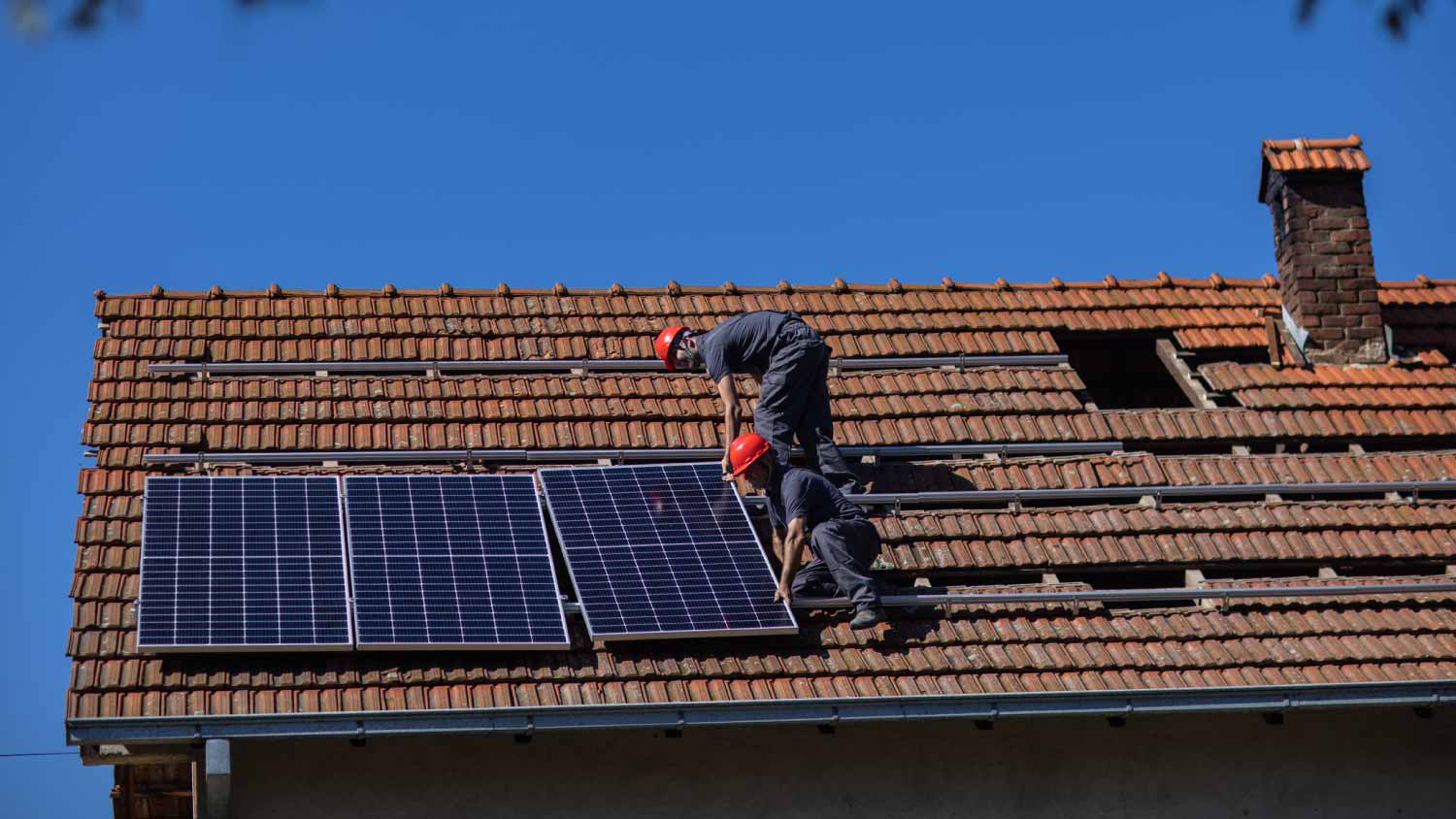
Solar inverters are a crucial part of your solar energy system. This guide breaks down solar inverter costs so you can estimate the price of your project.
They key to sizing your inverter is a simple ratio

Your solar inverter should match your solar array’s peak panel wattage, and a solar array sizing calculator helps, so 6 kW pairs with 6,000 watts.
Expect to pay $1,000 to $3,000 to install a new solar inverter if your current one is undersized or oversized and causing power losses.
Solar inverter sizing depends on how your panels’ total wattage compares with inverter output, plus your usage, location, system design, and future battery plans.
Hiring a local solar panel installation professional keeps calculations accurate and ensures your inverter matches your system for reliable energy conversion and efficiency.
If you plan to install solar panels, you’ll need a component called a solar inverter. This piece of tech transforms the direct current (DC) electricity produced by your panels into the alternating current (AC) electricity you can use in your home. Solar inverters come in different sizes, and you’ll need to check the output of your solar energy system to find the perfect match. This guide can serve as a solar panel inverter size calculator to help you find the right one.

Your solar power inverter needs to handle the output of your solar panels. For this reason, you should choose a solar inverter that’s similar in size to the DC rating of your solar array, the collective number of panels feeding into the inverter. The DC rating is the peak power output or the wattage your system can produce per hour. For example, if you have a 6-kilowatt (kW) solar energy system, use an inverter that has a maximum AC output of around 6,000 watts.
Keep in mind, this is just a rule of thumb. Solar panels don’t always perform at peak efficiency and your inverter will consume a small percentage of the DC electricity it needs to convert. Homeowners can size slightly down or up to find the right fit for their setup.
Your solar inverter size doesn’t need to match the DC rating of your solar panel array exactly. What’s most important is a figure called the array-to-inverter ratio. You can get this figure by dividing the DC rating of your solar panels by the AC power output of your inverter.
For example, a 6-kW array with a 6,000-watt inverter has an array-to-inverter ratio of 1. A 6-kW array with a 5,000-watt inverter has an array-to-inverter ratio of 1.2. The average installation has an array-to-inverter ratio between 1.15 and 1.25. Avoid ratios higher than 1.55, as these will not be sized correctly.
| System Size (kW) | Average Array-to-Inverter Ratio | Average Inverter Size (W) |
|---|---|---|
| 5 | 1.15–1.25 | 4,000–4,350 |
| 6 | 1.15–1.25 | 4,800–5,220 |
| 7 | 1.15–1.25 | 5,600–6,090 |
| 8 | 1.15–1.25 | 6,400–6,960 |
| 9 | 1.15–1.25 | 7,200–7,830 |
| 10 | 1.15–1.25 | 8,000–8,700 |
| 11 | 1.15–1.25 | 8,800–9.570 |
| 12 | 1.15–1.25 | 9,600–10,430 |
Different types of solar inverters lend themselves to different solar panel designs. You may have one big solar array that makes up your whole system, a couple smaller solar arrays, or inverters servicing each individual panel. Whatever the design, the size of your inverter should be similar to the DC rating of the connecting panel or panels.
| Type of Solar Inverter | Size of the Inverter |
|---|---|
| Single string inverter | Match the DC rating of the system |
| Multiple string inverters | Match the DC rating of the array |
| Microinverters | Match the DC rating of the panel |
String inverters connect multiple panels to make a solar array. This is the most common type of inverter used in residential solar energy systems, though commercial systems may have a larger central inverter. The size of the inverter depends on the design of the system:
Single string inverter: Most residential systems use a single string inverter. In this case, the size of your inverter should be similar to the DC power rating of your entire system.
Multiple string inverters: A large system uses two or three string inverters to create two or three different arrays. In this case, the size of your inverter should be similar to the collective DC power rating of the individual array.
Microinverters connect to an individual solar panel rather than multiple panels. They’re a common solution to reduce power loss when panels don’t receive equal sun exposure. The size of each microinverter should be similar to the DC power rating of the connected panel.

You can calculate your ideal solar panel inverter size using some simple math. Follow these steps:
Find the DC power rating of your panels: The DC power rating in watts should be listed in the owner's manual of your solar panels. Add up the wattage of each panel you plan to connect to the inverter to get the collective rating.
Convert kilowatts to watts: If your DC power rating is in kilowatts, you can convert it into watts since many inverters are sold based on their wattage. Multiply the number of kilowatts by 1,000 to get the total wattage.
Look for the array-to-inverter ratio: Your panel manufacturers will recommend a maximum ratio for their panels, which is below 1.55. You can figure out the minimum size of your inverter by dividing the DC rating (in watts) by the maximum ratio. For example, suppose you have a 6-kW system (6,000 watts) with a maximum ratio of 1.5. At a minimum, you’ll need a 4,000-watt solar inverter. Ideally, you’ll have a solar inverter closer to 6,000 watts.
Choose your inverter: You may undersize or oversize your inverter, but it can impact your energy output if you go overboard.
Keep in mind that this is only an estimate. You should consult a solar panel installer near you to ensure that your system is as efficient as possible.
It might be tempting to use a solar panel inverter size calculator to help you choose the right inverter. The truth is that these calculators can only give an estimate. A solar panel pro will make more detailed calculations beyond the maximum DC power output. They’ll consider the following factors:
Your solar inverter needs to be big enough to handle the output of your panels. Larger solar arrays with a lot of wattage require larger solar inverters.
Your contractor will look at your home’s energy use to design a suitable solar energy system. The average home uses around 30 kilowatt-hours of electricity per day. They’ll factor in the energy needs of specific appliances you plan to run, like your lights, television, and refrigerator.
String inverters have a higher capacity than microinverters because they service several panels. That said, there are a few reasons you’d choose a microinverter—like if your panels face different directions or are exposed to partial shade.
Your solar installer will also consider geography when sizing your solar inverter. Areas closer to the equator (like Arizona) experience higher levels of solar radiation than areas further from the equator (like Alaska). More solar radiation means more electrical output.
In sunny areas, your contractor will choose a solar inverter closer in size to the panels’ maximum DC output. In darker areas, it’s better to choose an undersized inverter.
Grid-tied systems connected to a utility gird don’t traditionally use a solar battery, but you might add a battery if you experience frequent power losses. This will impact your overall system design, so you might need more panels to charge more solar batteries and a larger inverter. You’ll also need an inverter that’s compatible with a battery.
Installing the wrong size solar inverter isn’t always an emergency, but it can impact your energy bill.
If your solar inverter is too big, it will lose some efficiency because it requires more energy to power itself. This will show itself in minor power losses, though it could noticeably drive up your electric bill if your inverter is oversized.
Some homeowners choose to install an oversized inverter if they plan to add panels to their system in the future. This allows for flexibility, but inverters are most efficient when their output is close to their maximum capacity.
If your solar inverter is too small, you might experience power losses and clipping, when solar panels produce more DC electricity than the inverter can convert into AC electricity. When clipping occurs, the undersized inverter reduces the voltage to a more manageable level, and the panels have reduced power output.
Clipping isn’t always a major loss. An array-to-inverter ratio of 1.5 only sees around a 2% to 5% power loss compared to an ideal ratio. If clipping significantly impacts your energy output and energy savings, you should install a new inverter. For most homeowners, the cost of a solar power inverter ranges from $1,000 to $3,000.
1 tree was cut down and 5 others including a large willow tree were trimmed. The Grant Tree Service men were professional and cleaned up afterwards. The cost of the 6 trees were affordable. I am very happy with the results. I would hire them again.
 Grants Tree Service
As usual with ECO, tech Jordan was outstanding, very professional, very knowledgeable, and very thorough with repairs made to tankless water heaters. Very highly recommend ECO!!!
 Eco Plumbers, Electricians, and HVAC Technicians
I conferred with 2 other contractors before Armstrong Electric. Nick and his crew showed me that the project was not as convoluted as the other contractors made it appear to be. They completed the entire project on time. They were professional, friendly and cleaned up after at completion. I...
 Armstrong Electric LLC
Window Depot did an amazing job on my deck. I wasnt sure what I wanted to do, but their composite decking was affordable and will last a long time. I am excited to have family over, and I am no longer embarrassed by my backyard. Jeff and the ground crew were polite, respectful, and caring for...
 Window Depot USA of Central Ohio
The techs on my project, Shawn and Cliff, were great. They were prompt, courteous, and efficient. I am very happy with the results and would definitely contact Mr. Electric for any future electrical projects.
 Mr. Electric of Columbus
Wonderful. I am going to have them remove and replace my driveway in the spring.
 All Star Paving and Sealing
Look forward to them getting started in our basement here soon. Extremely professional, very detailed and was a pleasure to have around. Anything we needed to work on or change in the middle of the project, they were open and willing to work with me.
 Jones & Sons Construction LLC
Did an amazing job transforming my yard. Also installed sod in places, would recommend to everyone.
 Cardinal Landscaping & Construction LLC
Manuel Calvillo is the best option in the area for roofing and you won't be disappointed.
There were some unsatisfactory issues with the product quality, no fault of Panel Town. They were handled quickly and professionally and in the end, exceeded my expectations. I believe that is a measure of a quality merchant. <br />
From average costs to expert advice, get all the answers you need to get your job done.
Solar inverters are a crucial part of your solar energy system. This guide breaks down solar inverter costs so you can estimate the price of your project.
Discover the average solar panel installation cost, key price factors, and expert tips to help you budget for your solar project.
Discover solar panel maintenance costs, including average prices, cost factors, and tips to save, empowering you to keep your solar system running efficiently.

What is a solar inverter? It’s a key part of your solar energy system. This guide will teach you how they work, the different types, and how to choose one.
Are you planning to go solar? This guide will explain the different types of solar inverters and help you choose the best one for your home.

Avoid underpowered solar batteries and wasted money. From daily energy use to depth of discharge, this guide explains how to size a battery for solar panels.